Identify the versions the parties are reviewing
A bilingual agreement may be produced as parallel columns, separate language files, or a principal contract with translated schedules. Record which versions are under negotiation and whether the contract addresses language precedence. Do not assume that a working English translation is an executed contractual text.
For Swiss work, language review should be coordinated with the lawyer responsible for the agreement. Use official legal sources such as Fedlex when researching an underlying legal concept; a dictionary equivalence alone cannot establish its contractual effect.
Map definitions to their uses
| Record | Purpose |
|---|---|
| Source term and definition | Preserve the exact agreed or proposed wording |
| Counterpart term | Identify how the other version renders the concept |
| Uses in operative clauses | Find obligations affected by the definition |
| Schedules and amendments | Check terms introduced outside the main body |
| Difference and decision | Separate a translation issue from a negotiation issue |
Ask the extraction tool to return missing and inconsistent uses explicitly. A blank result should not be treated as confirmation that both versions match.
Work through a scope difference
Suppose one version defines services to include transition assistance, while the other describes only the recurring service. The mismatch may affect fees, liability, termination, and the handover schedule. Correcting the definition without checking those provisions can leave the agreement internally inconsistent.
Trace every use of the term and record the affected obligations. Ask whether the difference reflects a translation error or an intentional commercial change. If the parties have not agreed the point, mark it as unresolved. A language editor should not decide the commercial scope by choosing the more natural sentence.
Review numbering, negation, and cross-references
Inspect paragraph numbering and references after any reorganisation. A clause pointing to section 8 in one language may point to an unrelated section in the other. Check exclusions and negative wording carefully, particularly in liability, confidentiality, and termination clauses.
Use side-by-side review to compare the source and proposed translation. Preserve citations or page references so another reviewer can reproduce the finding. Judicio can help organise those comparisons, but the legal and linguistic review remains with the team. Where a certified translation is required, arrange it separately.
Close the language review with a decision record
Before signature, reconcile the issue list against the final versions. Record which changes were linguistic, which changed the bargain, and which required specialist advice. Confirm that the final schedules and attachments are the ones reviewed.
Give the business a concise statement of remaining differences and assumptions. Keep both versions and the approved terminology record together for later amendments. When an amendment arrives in only one language, reopen the relevant definitions and linked clauses instead of treating the earlier bilingual review as permanently complete.
Worked example and decision record
Illustrative bilingual file: a Swiss supplier sends an English draft and a French draft, each labelled version 4. The English service definition includes exit assistance, while an attached French schedule describes exit assistance as optional work. The commercial question is whether the parties intended one service scope or two.
| Record | English file | French file / action |
|---|---|---|
| Definition | Services include transition assistance | Check the exact defined term and its scope |
| Fees | Main fee covers Services | Schedule prices exit assistance separately |
| Termination | Support continues during handover | Confirm whether a further order is contemplated |
| Decision | No automatic reconciliation | Counsel records agreed scope and affected clauses |
The comparison should not rewrite the bargain. Mark each affected clause, obtain the commercial instruction and then reconcile both language files. A language-precedence clause may affect interpretation, but it is not a reason to leave a known contradiction in a signing pack. Keep the original wording and the approved revision together so the reviewer can see the change.
Run a reviewable workflow
Open the approved source file in Translation, choose the target language and review the completed output with the source visible. Search for the defined term in both documents, then inspect each use in context. The interface supports document comparison; it does not determine contractual equivalence.
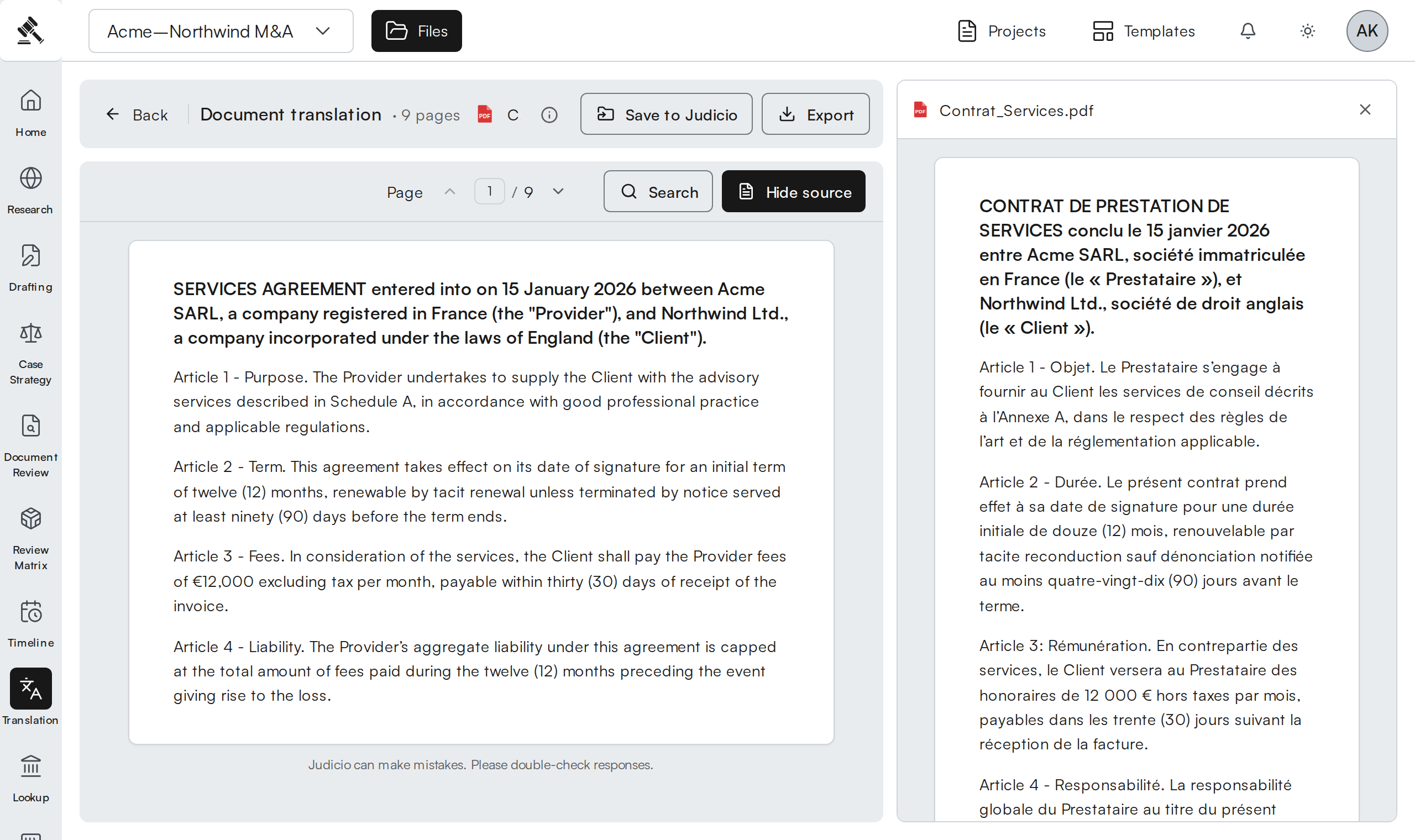
Use the same review sequence for termination wording, exclusions, negation and monetary amounts. Record references as file name, version, clause and page, because page numbers may differ between working files. Where the issue concerns a Swiss legal concept, consult Fedlex and the responsible Swiss adviser rather than treating a fluent English phrase as the legal definition.
Before export, check missing-page warnings, schedules, numbering and the language status of each file. Keep the working translation distinct from an executed counterpart or a formally certified translation. The recipient, forum and transaction determine what final language evidence is needed.
Checklist and acceptance criteria
Use this checklist at handover. Record the reviewer, date, source version and unresolved items beside each answer; a tick without evidence does not close the issue.
- Identify each negotiating and execution version.
- Trace defined terms into fees, liability, termination and schedules.
- Separate translation discrepancies from commercial instructions.
- Resolve negation, amounts and cross-references in both texts.
- Record who approved the bilingual signing pack and any remaining qualification.
Download the editable reconcile definitions in a bilingual swiss contract checklist (Markdown). It includes blank fields for your matter record and can be opened in a text editor or copied into your team’s document system.
Close the review when material differences have an authorised decision and the approved wording has reached every relevant file. A corrected translation with an unchanged contradictory schedule remains an open issue.
Sources and next steps
This is an editorial workflow guide for legal professionals. The suggested checks are our practical recommendations, not a statement that a regulator requires a particular software workflow.
Explore Translation and Review Matrix, or review Judicio's regional coverage and limitations. Check the underlying source and your organisation's approved process before relying on an output.